Post-Disaster Cultural Heritage Response: A Digital Coordination Architecture for Tactical Field Operations
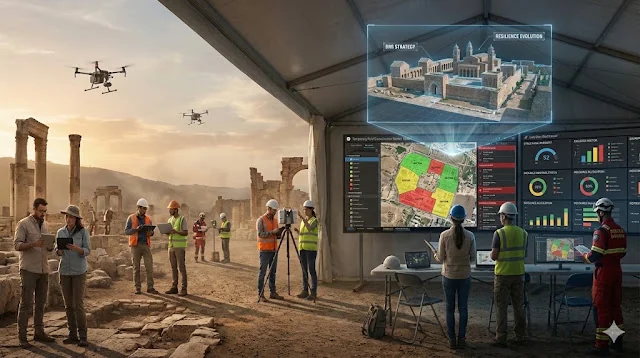
When the sirens of Urban Search and Rescue (USAR) teams fall silent, when the hope of finding a survivor under the rubble fades, and when the “golden hours” give way to a heavy, dusty silence, the nature of disaster management changes sharply. As the life-saving phase slows, a new race against time, weather, and secondary hazards begins.
On this page
- 1. Strategic Foundation: UNDRR, the Sendai Framework, and Community Resilience
- 2. Translating Operational Chaos into Structured Coordination: INSARAG-Inspired Sectorization and Triage Logic
- 3. Micro-Management and Relational Triage: Linking Movable and Immovable Heritage
- 4. The Dynamic Chessboard of Resources: Skill- and Safety-Based Routing
- 5. The Data Lifecycle: From Field Records to Actionable Intelligence
- 6. From Response Knowledge to DRR Evolution
- Conclusion: Technology as an Enabler of Coordinated, Accountable Action
- FAQ: Post-Disaster Cultural Heritage Digital Coordination
When the sirens of Urban Search and Rescue (USAR) teams fall silent, when the hope of finding a survivor under the rubble fades, and when the “golden hours” give way to a heavy, dusty silence, the nature of disaster management changes sharply. As the life-saving phase slows, a new race against time, weather, and secondary hazards begins.
Who Is This Article For?
- Disaster managers and emergency coordination units
- Cultural heritage emergency response professionals
- Public authorities planning CH-inclusive response systems
- GIS/data teams and software architects in disaster-tech
- Researchers designing evidence-based response workflows
What This Article Helps You Do
This article outlines a field-oriented conceptual architecture for coordinating post-disaster cultural heritage response in a structured, accountable, and data-driven way.
- Link sectorization, triage, tasking, and reporting
- Improve operational visibility with GIS-enabled workflows
- Support traceability through versioning and audit logic
- Clarify the boundary between AI support and human judgment
This is the race to protect Cultural Heritage (CH)—the memory, identity, and continuity of communities.
Imagine a 13th-century historical complex with a damaged load-bearing system, vulnerable to collapse under the next aftershock. Or a flooded archive of priceless manuscripts contaminated by asbestos, mold, and biological hazards. These are not conditions that can be safely or accountably managed at scale through pen-and-paper methods, informal messaging groups, or disconnected spreadsheets.
Post-disaster cultural heritage response requires an uncommon synthesis: the conservation sensitivity of ICOMOS and ICORP principles, the operational discipline of INSARAG-inspired coordination logic, the risk reduction vision of UNDRR, and modern software architecture. In complex, multi-site disasters, the most scalable and accountable way to operationalize this synthesis is through purpose-built digital coordination architectures.
Such systems can transform field observations, damage records, and spatial inputs into actionable geospatial intelligence for safe, timely, and accountable decision-making. This article examines the organizational philosophy behind post-disaster cultural heritage response, the digital backbone required to support it, and the pathway through which field data can evolve into long-term Disaster Risk Reduction (DRR) learning.
1. Strategic Foundation: UNDRR, the Sendai Framework, and Community Resilience
In many disaster contexts, protecting cultural heritage is still treated as a secondary concern—something to be addressed only after life-saving operations end. Yet this view is increasingly outdated. The Sendai Framework and its monitoring architecture explicitly recognize disaster losses affecting cultural heritage and support the integration of cultural heritage into broader resilience and DRR planning.
A persistent problem in post-disaster operations is the absence of clear, field-usable Standard Operating Procedures (SOPs) for interventions involving cultural heritage assets. When cultural heritage experts, archaeologists, architects, and conservators arrive after earthquakes, fires, or floods, they often encounter authority ambiguity, communication breakdowns, and fragmented situational awareness.
In many response systems, cultural heritage has historically been treated as a static object of protection. A modern and proactive approach treats it as a dynamic operational domain requiring risk-based coordination, safety controls, and time-critical prioritization. This is where carefully adapted tactical coordination principles—many proven in USAR and emergency response environments—can significantly strengthen cultural heritage operations.
2. Translating Operational Chaos into Structured Coordination: INSARAG-Inspired Sectorization and Triage Logic
For a first responder to cultural heritage arriving on a disaster site, the greatest threat is often not destruction alone, but the absence of coordination. In a wide geography where hundreds of historical buildings, museums, archives, and archaeological sites are affected, decisions cannot rely on intuition alone. Teams need to know where to go, what to prioritize, what risks are present, what capabilities are required, and what equipment is appropriate.
INSARAG’s sectorization and triage logic—originally designed for USAR coordination—offers a highly valuable operational prioritization model that can be adapted for cultural heritage emergency response.
Spatial Control: Sector–Worksite Hierarchy and the Common Operational Picture
A modern response architecture converts the affected field into a conceptual data model supported by geospatial information systems (GIS). The affected geography can be organized hierarchically:
- Sectors – large geographical areas (e.g., a historic peninsula, urban heritage quarter, or archaeological valley) divided using polygon boundaries and color-coded operational zones.
- Worksites – individual monuments, museums, archival repositories, historic building blocks, or excavation zones located within each Sector.
When this hierarchy is supported by digital coordination software, each damaged site is no longer only an address in a list. It becomes an operational record (or node) with coordinates, polygon boundaries, hazard tags, assigned personnel, timestamps, and status/version metadata.
National authorities and coordination cells (including OSOCC/UCC-style structures where applicable) can use a Common Operational Picture (COP) to monitor sector status, hazards, worksite progress, and resource constraints. The proposed architecture does not replace national incident command structures; it provides an interoperable digital coordination layer that can align with them.
Instead of managing one overwhelming crisis, coordinators manage a structured hierarchy of sectors, worksites, hazards, and tasks. This improves safety, traceability, and operational clarity.
At minimum, each worksite record should support unique identifiers, assessment versioning, media attachments, and audit-ready event logs.
3. Micro-Management and Relational Triage: Linking Movable and Immovable Heritage
One of the greatest weaknesses of non-digital response systems is the creation of data silos. Structural damage assessments of buildings (immovable heritage) are often recorded separately from inventories of artifacts, manuscripts, paintings, or liturgical objects (movable heritage). In practice, however, these are inseparable.
The structural integrity of a building directly influences the survival probability, access conditions, and emergency handling requirements of the objects inside it. A museum hall with a partially collapsed roof is a rapidly evolving risk environment—even if display cases initially appear intact.
A robust software architecture links these two operational domains (immovable and movable heritage) through explicit data relationships in an RDBMS or graph-based model, enabling risk propagation, traceability, and task prioritization.
A Risk-Informed Escalation Workflow
A structural engineer or ICORP-trained architect in the field may use an offline-capable mobile tool to assign a damage condition to a building or structural element. If the entered status is “SEVERE” or “COLLAPSED,” the system can trigger a provisional escalation workflow in the background.
It scans movable heritage records linked to that building ID and flags them for Priority Red List review based on hazard severity, timestamp freshness, and assessor role.
To reduce false escalation and avoid cascading errors, the workflow should support:
confidence scoring
role-based validation
verification status
(e.g., provisional / confirmed / superseded)
audit trails
version history
time-stamped provenance
All changes should be traceable. This is essential not only for operational safety, but also for accountability, donor reporting, and after-action learning.
In cultural heritage response, triage should also incorporate CH-specific criteria such as significance/value, physical condition, salvage feasibility, contamination exposure, access constraints, and expected secondary hazard progression.
This marks a shift from reactive response toward risk-informed, data-driven coordination—with increasing predictive capability as validated operational datasets mature.
4. The Dynamic Chessboard of Resources: Skill- and Safety-Based Routing
The most valuable and most constrained resource on a disaster site is human capability. In large-scale incidents involving national and international actors (including civil protection deployments, cultural heritage networks, and specialized volunteer groups), the challenge is not simply the number of people available—it is whether the right people can be matched to the right tasks under the right safety conditions.
Not every expert can perform every task. A conservator may be highly skilled in emergency packing but not qualified to work under an unstable masonry vault. A structural engineer may be able to design temporary shoring but lack the conservation knowledge needed for handling waterlogged parchment or fragile painted surfaces.
Advanced response platforms can maintain structured personnel profiles for field registration and tasking. These profiles may include:
- competence domains (DRM / CH / structural / conservation / logistics)
- certifications and training records
- language skills
- physical capability constraints
- safety clearance level
- current operational status (available / assigned / resting / demobilized)
Where used, such profiles should be governed by data protection rules and least-privilege access.
The system functions as a skill and availability matching engine, combining personnel metadata, location, safety constraints, and task requirements. When a field request arrives (for example, emergency structural stabilization plus heavy-object movement), the platform can generate a dispatch recommendation—team composition, route, and equipment profile—for coordinator validation before deployment.
Human validation remains essential, especially for safety-critical assignments involving unstable structures, contamination, or restricted access zones.
This is a high-impact integration of resource management principles into cultural heritage emergency coordination, improving operational precision, reducing resource waste, and strengthening expert safety.
5. The Data Lifecycle: From Field Records to Actionable Intelligence
Thousands of data points collected in the field—coordinates, damage grades, hazard categories, photo logs, inventories, chain-of-custody records, and emergency intervention forms—do not create value automatically. In crisis conditions, raw data alone has limited operational value. What matters is validated, contextualized information and actionable intelligence.
The transition from data to intelligence depends on data quality, metadata completeness, timestamp integrity, and clear provenance.
A well-designed coordination platform should do more than collect records. It should support a data pipeline that transforms structured field inputs into operational outputs in near-real time.
5.1 Visualization and Operational Risk Mapping
Structured field data can be visualized on GIS basemaps and satellite imagery through interoperable geospatial services and common formats (e.g., GeoJSON, KML, and other operational exports). Instead of scanning disconnected forms, decision-makers can view:
concentration of severe damage by sector
contamination hotspots
unstable structures awaiting shoring
evacuation task backlogs
completed interventions and safe transfer routes
This significantly improves situational awareness by making risk concentration, task backlog, and operational progress visible at sector and worksite level.
5.2 Near-Real-Time, Traceable Reporting
In international and multi-agency response environments, mission leadership, public authorities, and donors routinely request Situation Reports (SitReps), mission updates, and evidence-based summaries. Without digital support, field teams can become overloaded by repetitive reporting demands.
A strong implementation can generate draft reports from structured operational data and template-based workflows, reducing reporting burden and improving consistency. Outputs may include standardized PDFs, KML files, and machine-readable exports for downstream analysis or donor systems.
To remain credible and auditable, the reporting pipeline should include:
- machine-generated draft + human review
- version control
- source traceability
- time-stamped summaries
- linked media references
Multilingual reporting support is also highly valuable in international missions and cross-border coordination settings.
6. From Response Knowledge to DRR Evolution
The long-term success of a disaster response system is not measured only by how well it managed one operation. It is also measured by how effectively it contributes to future risk reduction, preparedness, and resilience policy.
When emergency operations end and rehabilitation begins, a high-value operational data repository remains inside the system. This repository can become more than an archive—if data quality, metadata completeness, and provenance standards were preserved during the response.
Its long-term value depends on governance: what was collected, by whom, under which conditions, with what confidence, and how it was verified.
With those conditions in place, analysts, disaster managers, and heritage professionals can begin to answer critical questions with evidence-based confidence:
- Which building typologies performed better under specific hazard conditions?
- Which interventions reduced secondary damage most effectively?
- What equipment or specialist capabilities were missing in the first 24–72 hours?
- Which storage, display, or packing practices reduced losses in movable heritage collections?
- Which sectors consistently generated access delays, and why?
The software’s relational logs—linking typology, condition, intervention, hazards, and outcomes—can support evidence-based analysis with measurable confidence.
With appropriate governance, anonymization/redaction, and validation, portions of this dataset may also support statistical modeling, machine learning, and AI-assisted scenario analysis. Not all operational data should be used for model training, especially where sensitive site information, security constraints, or chain-of-custody details are involved.
Under these constraints, the system can support preparedness planning, scenario-based pre-positioning, and preventive protection measures by identifying vulnerable asset typologies and high-risk sectors under defined hazard scenarios.
These outputs should be treated as decision support for planning—not as autonomous predictions replacing expert judgment or official warning systems.
6A. Governance, Authority, and Data Protection
A deployable coordination architecture must define authority mapping as clearly as it defines data models. This includes practical questions such as:
- Who authorizes access to damaged heritage sites?
- Who validates structural safety for entry?
- Who approves emergency evacuation of movable heritage?
- Who signs chain-of-custody transfers?
- Who can release public-facing information?
These decisions vary by national legal frameworks and institutional structures, but they cannot be improvised in the middle of a crisis.
The platform should also implement data protection and operational security controls, including:
RBAC, least-privilege access, encrypted offline storage, geolocation masking, redacted public reporting, audit-ready access logs
AI-assisted recommendations must remain human-supervised, especially in safety-critical, legally sensitive, or politically sensitive decisions.
6B. Minimum Viable Digital Architecture for Cultural Heritage Emergency Response
Before advanced analytics or AI layers are introduced, a deployable system should provide a reliable operational foundation. At minimum, a Minimum Viable Digital Architecture (MVDA) should include:
- Asset/Worksite Registry – linked records for immovable and movable heritage, unique IDs, baseline metadata
- Offline-Capable Field Tools – assessment forms, photo capture, hazard tagging, task updates, local encrypted storage
- GIS-Based Operational Dashboard – sector/worksite COP, hazard visualization, task status, resource overview
- Tasking and Coordination Engine – assignment workflows, dispatch recommendations, validation checkpoints
- Template-Based Reporting Pipeline – SitRep drafts, mission summaries, exportable maps and structured outputs
- Audit and Versioning Layer – time-stamped logs, assessment versions, change history, source traceability
- Interoperability-Ready Exports/APIs – machine-readable outputs and common geospatial formats for external coordination
Advanced functions such as predictive prioritization and AI-assisted planning should be layered on top of this foundation only after sufficient data quality and validation maturity are achieved.
Implementation Risks to Watch
- Low-quality field data causing mis-prioritization
- Offline sync conflicts and version inconsistencies
- Role ambiguity in approval and escalation flows
- Exposure of sensitive heritage location/data records
- Over-automation in high-risk operational decisions
- Tool adoption friction under time pressure
Conclusion: Technology as an Enabler of Coordinated, Accountable Action
Cultural heritage is not a static collection of stones, bricks, and manuscripts. It is the material expression of memory, identity, belonging, and continuity. Protecting it after disaster demands more than goodwill or isolated conservation efforts. It requires coordinated action under uncertainty.
Integrating the resilience logic of DRR, the scientific rigor of cultural heritage conservation, and the operational discipline of emergency coordination requires a disciplined combination of people, process, and platform.
In practice, resilience outcomes improve when three elements evolve together:
People
trained multidisciplinary teams with clear roles and safety awareness
Process
SOPs, authority mapping, accountability, and operational discipline
Platform
data, GIS, tasking, reporting, and decision-support architecture
Digital coordination systems do not replace expertise. They make expertise more effective under pressure. They transform field chaos into structured operational visibility, support safer prioritization, and convert granular operational records into strategic learning for future risk reduction.
Technology, software, and AI do not save cultural heritage by themselves. Cultural heritage is protected by trained people—working within clear protocols, supported by strong coordination, and empowered by high-quality information.
If we want to carry the heritage of the past safely into the future, we must bring today’s best engineering, data governance, and operational intelligence into the field—carefully, responsibly, and in service of human judgment.
FAQ: Post-Disaster Cultural Heritage Digital Coordination
Does this architecture replace national incident command systems?
No. The proposed architecture is an interoperable digital coordination layer designed to align with national command and coordination structures, not replace them.
Why are spreadsheets and informal messaging not enough in large disasters?
They become difficult to audit, synchronize, and scale across many damaged sites, teams, hazards, and reporting demands. A structured platform improves traceability, situational awareness, and operational clarity.
What is the minimum digital architecture needed to start?
At minimum: a worksite/asset registry, offline-capable field tools, a GIS-based operational dashboard, a tasking/coordination workflow, template-based reporting, audit/versioning, and interoperability-ready exports.
Can AI autonomously prioritize interventions or dispatch teams?
AI can support prioritization and recommendations, but decisions should remain human-supervised—especially in safety-critical, legally sensitive, or politically sensitive operations.
Why is linking movable and immovable heritage important?
Because building condition directly affects the safety, accessibility, and salvage priority of the objects inside. Separate records create operational blind spots.
Is this only useful for earthquakes?
No. The coordination logic is relevant to multi-site cultural heritage impacts after earthquakes, floods, fires, and other hazards, with adaptation to local legal and operational contexts.
No comments yet. Be the first.