A Scientific Milestone: My First Paper on the 6 February Earthquakes Published in Journal of Risk Research
This paper might be a small contribution to the global scientific community, but for me, transforming our raw field experience into a published article is a monumental milestone. I am thrilled to announce that our research, "Reflecting on the 6 February 2023, Türkiye-Syria earthquake," has been published in the prestigious Journal of Risk Research.
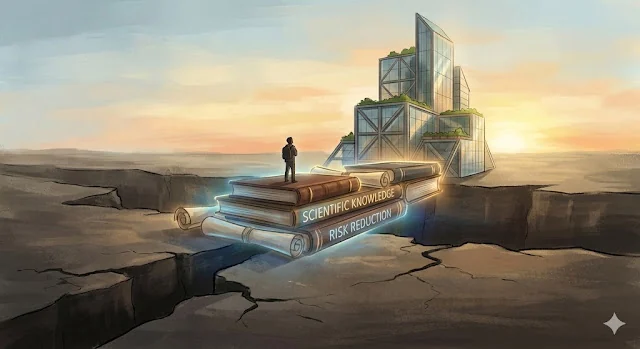
Reflecting on the 6 February 2023 Earthquakes through the lens of science and resilience.
"I am inverting Neil Armstrong's iconic words to reflect on this study today: 'One small step for mankind, one giant leap for me.'"
This paper might be a small contribution to the global scientific community, but for me, transforming our raw field experience into a published article is a monumental milestone. I am thrilled to announce that our research, "Reflecting on the 6 February 2023, Türkiye-Syria earthquake," has been published in the prestigious Journal of Risk Research.
The Scale of the Catastrophe
On February 6, 2023, the geography of our lives changed forever. Two major earthquakes (Mw 7.7 and Mw 7.6) struck southeastern Türkiye, directly impacting 14 million people across a vast area of roughly 120,000 km². The destruction was not just a statistic; it was a lived reality for millions.
As someone working in disaster management, witnessing entire city blocks reduced to rubble—where 37,984 buildings collapsed and over 240,000 were left unusable—was a professional call to action. Together with my colleagues Yeliz Teker and Dr. Ayşe Yıldız, we embarked on a journey to document these events scientifically. Our goal was simple yet ambitious: to extract lifesaving lessons from the debris.
Lesson 1: The "Silent Killer" was Vulnerability, Not Just Magnitude
A critical finding of our research is that the seismic magnitude alone does not explain the scale of loss. The true killer was the structural vulnerability of the built environment. We observed that many buildings, including contemporary high-rise apartment blocks, failed to protect their inhabitants due to non-compliance with building codes and design irregularities like "soft stories".
However, there was a beacon of hope in the data: The city of Erzin. Despite being in the affected zone, Erzin saw almost no building collapses. Our paper highlights this as a powerful case study proving that long-term enforcement of construction standards can—and does—save lives.
Lesson 2: Preparedness Meets Reality
Disaster plans often exist in a vacuum of "ideal conditions." The February 6 earthquakes shattered that illusion. The disaster was compounded by harsh winter conditions, which complicated response efforts and increased the risk of hypothermia for survivors.
Furthermore, our analysis of the health infrastructure revealed a stark reality: 20 hospitals sustained heavy damage, and 243 primary care facilities were severely impacted across the eleven provinces. This forced a rapid, improvised transfer of services to tent units. The lesson is clear: Future contingency plans must anticipate "compound hazards"—such as an earthquake coinciding with a winter storm—and test the resilience of critical infrastructure under these extreme scenarios.
Lesson 3: The "Golden Window" and Coordination
The first 72 hours—the "golden window" for rescue—presented immense challenges. While the mobilization was historic, with over 270,000 personnel and international teams from over 100 countries deployed, communication breakdowns hampered the initial coordination.
We found that disrupted cellular networks and power outages isolated several communities in the critical early hours. However, the response also highlighted the incredible power of civil society. In many cases, neighbors were the first responders, a phenomenon that suggests we should formalize "Community Emergency Response Teams" (CERTs) as a standard part of our national strategy.
Conclusion
This paper is more than an academic exercise; it is a roadmap. The Türkiye-Syria earthquake underscored that while natural hazards are inevitable, disasters are preventable. By integrating these lessons into our policies and practices, we honor the memory of those we lost.
I look forward to sharing more technical deep-dives from this paper in upcoming posts.
Rıdvan Bilgin
Disaster Risk Management Specialist | AFAD Bursa
Combining field experience with academic research to build safer communities.
Publication Details
"Disasters are not natural. They are shaped by prior decisions on land use, building safety, and governance."
No comments yet. Be the first.